How Solar Powered Timelapse Camera Systems Work in UAE Construction Sites
The UAE gets an average of 3,500 hours of sunshine per year. It is one of the sunniest places on earth. And yet, most construction site cameras here are still running off mains power, tethered to a supply that can be cut by a single contractor with a shovel in the wrong place.
There’s a certain irony in that. The country with near-perfect conditions for solar power is still running extension cables across active construction sites, losing footage every time the temporary power supply goes down. A solar powered timelapse camera is not a workaround in the UAE — it is the most reliable power solution available. Understanding how these systems actually work, and what makes them succeed or fail in Gulf conditions, is what this guide is about.
The Misconception About Solar Power on Construction Sites
Most people assume solar-powered cameras are a compromise — something you use when mains power isn’t available, at the cost of reliability. That assumption is wrong, and it’s wrong in a specific way that matters for UAE projects.
On a construction site, mains power is the unreliable option. It depends on temporary infrastructure that gets disrupted regularly: trenching works, cable relocations, generator fuel supply gaps, and accidental damage from plant equipment. A properly specified solar powered timelapse camera operates independently of all of that. The sun rises, the panel charges, the battery maintains overnight operation. That cycle is more predictable than any site electrical supply.
Mains power feels reliable because it’s familiar. On an active construction site, it is neither.
The caveat is sizing. Undersized solar systems fail in ways that are hard to detect — the camera continues operating but drops overnight recording when the battery runs low, or reduces frame rate to conserve power during peak demand. You end up with gaps that only become visible when you review footage weeks later. Getting the sizing right matters more than the panel brand or the camera model.
A correctly sized solar system is more dependable than site power. An undersized one creates gaps that look exactly like gaps caused by anything else.
How the System Actually Works — Without the Technical Padding
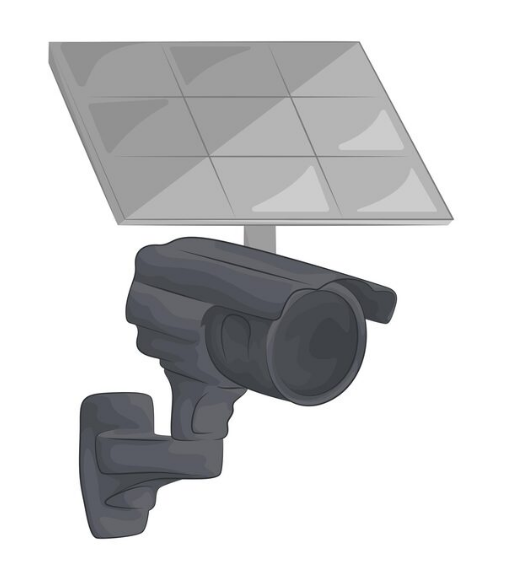
A solar powered timelapse camera system has four components working together: the panel, the charge controller, the battery, and the camera unit. Each has a specific role, and failure in any one of them brings down the whole system. Understanding what each component does helps you evaluate what you’re being quoted for.
The Panel
The panel converts sunlight into DC electricity. In UAE conditions, a monocrystalline panel — higher efficiency than polycrystalline, better performance at high temperatures — is the right choice. Panel output is rated in watts under standard test conditions (STC), which assumes 25°C cell temperature. In the UAE summer, cell temperatures routinely exceed 65°C, which reduces actual output by 15 to 25% from the rated figure. Your system needs to be sized for real-world output, not the number on the panel’s specification sheet.
The Charge Controller
The charge controller regulates the power flow between the panel and the battery. MPPT (Maximum Power Point Tracking) controllers are more efficient than PWM controllers in conditions where panel voltage fluctuates — which includes partial shading from site equipment, dust accumulation on the panel surface, and early morning or late afternoon sun angles. On a UAE construction site, MPPT is not a premium option; it is the minimum specification for consistent charging performance.
The Battery
The battery stores energy for overnight operation and low-light periods. Lithium iron phosphate (LiFePO4) chemistry is the correct choice for UAE deployment. Standard lead-acid batteries — still quoted by some suppliers — lose 30 to 40% of their rated capacity above 40°C. LiFePO4 batteries maintain performance across the operating temperature range of a UAE site and have a cycle life three to four times longer than lead-acid under the same conditions.
Field Example
A mixed-use development project in Sharjah deployed eight solar powered timelapse cameras across a large site in early spring. Six units used LiFePO4 battery packs; two used sealed lead-acid batteries sourced by a subcontractor at lower cost. By June, both lead-acid units were failing to maintain overnight recording — batteries depleted by 3am and cameras restarting at dawn without the previous night’s footage.
The project team replaced the lead-acid batteries with LiFePO4 packs in July. Both units performed without interruption for the remainder of the project. The replacement cost, including labour, was three times what the battery upgrade would have cost at initial specification. The footage gaps from months four through six were not recoverable.
Battery chemistry is the most consequential specification decision in a UAE solar camera deployment, and it’s the one most often made on price alone.
Sizing the System for UAE Conditions — The Numbers That Matter
A solar powered timelapse camera running 4K capture at five-minute intervals, with cellular uplink active, draws approximately 3 to 5 watts continuously during operation. Overnight, with the camera in low-power mode but maintaining cellular connectivity, draw drops to 0.5 to 1.5 watts. For a 12-hour operational day, you need roughly 40 to 60 watt-hours of energy from your panel and battery system combined.
In UAE summer conditions, accounting for thermal derating, a 40W monocrystalline panel will realistically generate 150 to 180 watt-hours on a clear day — comfortably covering camera demand and recharging the battery. During a Shamal event with significant dust on the panel surface, that drops to 60 to 80 watt-hours. Your battery needs enough reserve to bridge two to three consecutive poor-generation days without the camera dropping recording.
| System Component | Minimum UAE Spec | Recommended UAE Spec | Why It Matters |
| Solar Panel | 30W monocrystalline | 50W monocrystalline | Thermal derating reduces output; headroom ensures consistent charging |
| Charge Controller | PWM 10A | MPPT 10–20A | MPPT recovers 15–25% more energy under variable conditions |
| Battery | 40Ah LiFePO4 | 60–80Ah LiFePO4 | 3-day autonomy buffer for dust events and overcast periods |
| Battery Chemistry | LiFePO4 only | LiFePO4 only | Lead-acid loses 30–40% capacity above 40°C; unsuitable for UAE |
| Panel Tilt Angle | Fixed at 24° (Dubai latitude) | Adjustable seasonal mount | Optimal tilt improves winter generation by up to 18% |
These numbers apply to a standard timelapse camera unit. If your deployment includes external lighting for night capture, PTZ functionality, or edge AI processing, your power draw increases significantly — recalculate accordingly.
Size for the worst week of the year, not the average day. The average day will take care of itself.
Panel Placement on an Active Construction Site
This is the part of a solar powered timelapse camera installation that receives the least planning and causes the most problems. Panel shading — even partial shading — has an outsized impact on output. A single shadow from a crane boom covering 20% of a panel’s surface can reduce system output by 50% or more, depending on the panel’s cell configuration.
On an active construction site, shading sources move constantly. Equipment is repositioned, temporary structures go up, neighbouring buildings rise and cast new shadows. A panel position that is fully unobstructed in month one may be partially shaded by month four. The best outdoor wireless security camera system solar powered deployments include a shading analysis at the start of each major project phase — not a one-time assessment at installation.
Dust accumulation on the panel surface is the other siting factor. A horizontally mounted panel in a UAE construction environment accumulates enough dust within two to three weeks to reduce output by 10 to 20%. Tilt the panel at the latitude angle — 24 to 25 degrees for most UAE sites — and natural wind clears a significant proportion of that accumulation. Flat mounting is a maintenance problem in disguise.
A panel pointing at the right angle, cleaned monthly, will outperform an oversized flat-mounted panel every time.
Panel placement deserves a site survey, not a five-minute decision on installation day.
Connectivity: The Other Half of the Equation
A solar powered timelapse camera in the UAE operates independently of site power, but it still needs to transmit footage. Cellular connectivity — 4G LTE as a minimum, 5G where the site location supports it — is the standard transmission method for a best outdoor wireless security camera system solar powered configuration. It keeps the camera independent of site network infrastructure and allows remote access from anywhere.
The interaction between cellular uplink and power consumption is worth understanding. Cellular transmission is the single highest power draw event in a timelapse system — uploading 4K footage over LTE can consume 3 to 4 times the power of the camera’s recording function. Systems that upload continuously draw significantly more power than those configured to batch-upload during off-peak hours.
For deployments managed under a professional Solar Power Camera System for Outdoor service, upload scheduling is typically configured as part of system setup — batching uploads to early morning when the battery is fully charged and generation is beginning. It’s a detail that extends battery reserve by measurable margins without affecting the completeness of the footage archive.
Local SD card storage provides the fallback. When cellular signal is unavailable — during site events, poor coverage zones, or network maintenance — the camera continues recording locally and syncs when connection is restored. A 256GB SD card stores roughly 90 days of standard-interval 4K footage, which is more than sufficient for most project phases.
Connectivity and power are not separate systems — how your camera uploads footage directly affects how long the battery lasts.
Maintenance That Actually Needs Doing
A solar powered timelapse camera running a professional Timelapse Service for Construction & Infrastructure Project is not a fit-and-forget installation. It requires a small number of regular maintenance actions that, if skipped, compound into system failures over a UAE summer.
- Panel cleaning: every 3 to 4 weeks on active earthworks sites, every 6 to 8 weeks on finished or low-dust environments
- Connection inspection: check solar and battery terminals for corrosion every 3 months — salt air on coastal sites accelerates this
- Battery state-of-health check: review charge cycles and capacity via the monitoring platform every 6 months
- Mount stability inspection: verify panel and camera mast fixings after any significant wind event or Shamal
Remote monitoring handles the rest. A properly configured system sends alerts when battery voltage drops below threshold, when panel output falls outside expected range, or when the camera loses connectivity for more than a defined period. You shouldn’t need to visit the site to know the system is healthy — the system should tell you when it isn’t.
Maintenance on a solar camera system takes less time than replacing the footage gaps it prevents.
What You’re Probably Wondering
How many days can the system run without sunlight before the camera stops recording?
With a correctly sized LiFePO4 battery — 60Ah minimum for standard timelapse operation — you have two to three days of full operation without any solar generation. In practice, the UAE rarely has more than one consecutive overcast day, so this buffer is almost never fully consumed. The risk isn’t prolonged cloudy weather; it’s an undersized battery combined with a dusty panel and a cellular uplink running continuously. Get those three variables right and the autonomy question becomes irrelevant.
Can I use the same solar panel and battery that came with a consumer-grade outdoor camera?
No, and the reason is straightforward. Consumer solar camera kits are designed for temperate climates with moderate sun and moderate temperatures. They use small panels — typically 5 to 15W — and lead-acid or low-capacity lithium batteries not rated for high-temperature cycling. In UAE conditions, that combination will fail within the first summer. A purpose-specified solar powered timelapse camera system starts at 30 to 40W panel capacity with LiFePO4 battery chemistry. There is no shortcut that bridges that gap reliably.
Does the heat actually damage the solar panels themselves?
Not damage in the sense of immediate failure — but sustained high temperatures reduce panel efficiency over time and accelerate degradation of the EVA encapsulant that seals the cells. Quality monocrystalline panels from established manufacturers are rated for 25-year outdoor life under standard conditions; UAE conditions will shorten that somewhat, but for a 1 to 3 year construction project deployment, panel degradation is not a meaningful concern. The thermal issue to manage is output derating during operation, not physical panel damage.
Can the solar system power night vision or lighting for 24-hour recording?
Yes, but the power budget changes significantly. IR night vision LEDs add 3 to 8W depending on range and intensity. Active white light adds considerably more. You need to recalculate the full system power demand including lighting before sizing panels and batteries. A system designed for daylight-only recording will not sustain 24-hour operation without being significantly upsized. If 24-hour capture is a requirement from the start, specify for it at the design stage rather than retrofitting later.
How does the best outdoor wireless security camera system solar powered handle the camera’s cellular data costs?
Data consumption depends almost entirely on capture resolution and upload frequency. A 4K timelapse on 5-minute intervals, uploading continuously over LTE, consumes 15 to 30GB per month. Configured with batch uploading and compressed preview streams for live monitoring, the same camera runs on 5 to 10GB monthly. Most professional deployment services include data SIM management and can throttle or schedule uploads to stay within agreed data budgets. It’s worth discussing upload configuration explicitly rather than assuming it’s optimised by default.
My project runs from September through April — the cooler months. Do I still need to over-specify the system?
For thermal management, no — September to April in the UAE is significantly more forgiving than summer. For dust resilience, yes. Dust is a year-round problem. For power, you still need to size for the worst-case scenario of consecutive overcast days, which can happen even in winter. Underspecifying for the cooler months is a common mistake that leads to footage gaps when you least expect them.
A solar powered timelapse camera system built for Gulf conditions — right panel size, right battery chemistry, right charge controller, right upload schedule — will outlast the project it’s deployed on and produce a complete record with minimal intervention. The specification decisions that make that possible take about an hour to get right at the start. They take considerably longer to correct after a UAE summer has exposed every shortcut.